

Non-emergency medical transportation (NEMT), the coordinated rides that get patients to dialysis, chemotherapy, discharge appointments, and routine care when they can't get there on their own, is one of the fastest-growing corners of healthcare logistics. The US market is valued at roughly $12.4 billion in 2026 and is on track to reach $18 to 19 billion within the next several years, driven by an aging population, Medicaid expansion, and the industry's shift toward value-based care.
An aging population is doing a lot of the pushing: with older adults booking medical visits roughly three times as often as younger patients, and the 65-and-older population climbing toward 73 million Americans this year, the volume of trips that need coordinating is only going one direction.
Where all the money is actually going
Growth is attracting a wave of new entrants and consolidation. Technology-led brokers and traditional providers are both expanding their footprints, and digital-first companies are pouring money into AI dispatch and real-time tracking. Most of that investment is landing in the same place: scheduling dashboards, routing engines, and broker portals. That software is genuinely useful, it's how coordinators book rides, track trips, and produce clean billing records, but it only solves half the equation. The other half is having enough credentialed drivers and accessible vehicles on the road to actually complete the trips the software plans.
That's the real constraint in NEMT right now. The technology to plan a trip well is increasingly common. The supply to complete it, especially wheelchair-accessible and specialized vehicles, is not. As the market grows, the providers who can pair good software with a live supply network are the ones positioned to actually absorb that growth.
Where Curb fits
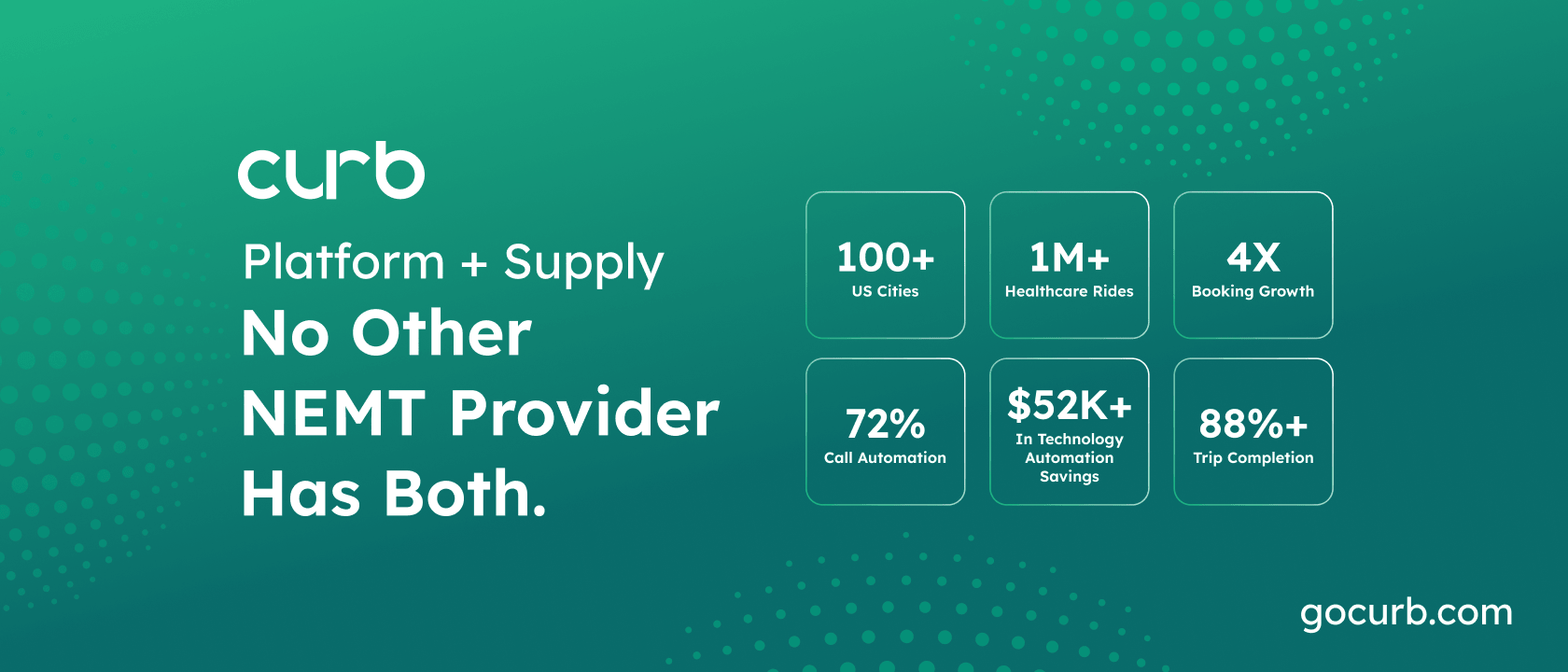
Curb pairs both halves under one network: HIPAA-compliant coordination software (Curb Health), an open API that routes demand across supply in real time (Curb Flow), AI-powered routing (Curb Optima), and a live network of 100,000+ licensed drivers across 100+ US cities, including the largest wheelchair-accessible vehicle supply in North America. The software gets a trip planned correctly. The network is what gets it completed. It's having both, not either alone, that lets a health plan or broker actually scale a program instead of just scheduling one better.
See it at NEMTAC Transform
We're sponsoring NEMTAC Transform 2026, August 16 to 19 in Orlando, Florida. Find us at booth 321; we'd like to hear what's actually slowing your program down.


.png)
.png)







---Optimized.jpg)







.jpg)


.jpg)


