What Cities Need From a Mobility Partner Right Now

September 3, 2026
Blog

Cities are being asked to do more with transportation than they've ever had to before: expand access for riders who need it most, meet new state and federal data mandates, and stand up emergency transportation on short notice, usually with no extra budget, staff, or infrastructure to do any of it. The agencies making real progress on these fronts generally aren't buying more systems. They're finding partners who can operate inside the systems already in place.

That's the role Curb plays for more than 100 cities today, across a network built on 500M+ trips and 100K+ vehicles.

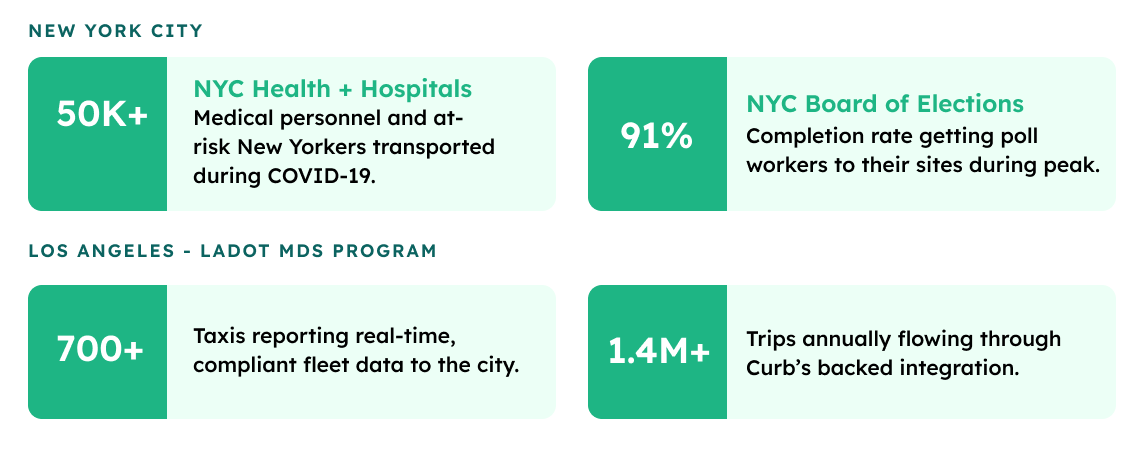
In Los Angeles, that meant satisfying all five Mobility Data Specification requirements (capacity optimization, trip and status tracking, digital geofencing, accessibility compliance, and fare and fee auditing) without disrupting how the city's existing taxi fleet already operates. Curb integrates directly on the backend, delivering compliant, real-time data at no added cost or overhead to the city.

And when cities need transportation fast, Curb has been the partner they call, whether that's moving medical personnel during a public health crisis or getting poll workers where they need to be on Election Day. The same reliability shows up in the everyday compliance work most riders never see.
The same responsiveness holds outside declared emergencies too. When bus service falls short, Curb has helped keep Chicago Public Schools students moving to and from class on a regular and emergency basis.

Curb's combination of technology and operations, paired with a proven ability to respond when city needs change, makes it a partner regulators can build on, not just a vendor they have to manage.

Curb is proud to sponsor IATR's 39th Annual Conference, September 14 to 17 in Las Vegas. Come talk about cities, data, and mobility with our team.

Ready to ride?

Download Curb

What Cities Need From a Mobility Partner Right Now

September 3, 2026
Blog

Cities are being asked to do more with transportation than they've ever had to before: expand access for riders who need it most, meet new state and federal data mandates, and stand up emergency transportation on short notice, usually with no extra budget, staff, or infrastructure to do any of it. The agencies making real progress on these fronts generally aren't buying more systems. They're finding partners who can operate inside the systems already in place.

That's the role Curb plays for more than 100 cities today, across a network built on 500M+ trips and 100K+ vehicles.

In Los Angeles, that meant satisfying all five Mobility Data Specification requirements (capacity optimization, trip and status tracking, digital geofencing, accessibility compliance, and fare and fee auditing) without disrupting how the city's existing taxi fleet already operates. Curb integrates directly on the backend, delivering compliant, real-time data at no added cost or overhead to the city.

And when cities need transportation fast, Curb has been the partner they call, whether that's moving medical personnel during a public health crisis or getting poll workers where they need to be on Election Day. The same reliability shows up in the everyday compliance work most riders never see.

The same responsiveness holds outside declared emergencies too. When bus service falls short, Curb has helped keep Chicago Public Schools students moving to and from class on a regular and emergency basis.

Curb's combination of technology and operations, paired with a proven ability to respond when city needs change, makes it a partner regulators can build on, not just a vendor they have to manage.

Curb is proud to sponsor IATR's 39th Annual Conference, September 14 to 17 in Las Vegas. Come talk about cities, data, and mobility with our team.

Ready to ride?

Download Curb

What Cities Need From a Mobility Partner Right Now

September 3, 2026
Blog

Cities are being asked to do more with transportation than they've ever had to before: expand access for riders who need it most, meet new state and federal data mandates, and stand up emergency transportation on short notice, usually with no extra budget, staff, or infrastructure to do any of it. The agencies making real progress on these fronts generally aren't buying more systems. They're finding partners who can operate inside the systems already in place.

That's the role Curb plays for more than 100 cities today, across a network built on 500M+ trips and 100K+ vehicles.

In Los Angeles, that meant satisfying all five Mobility Data Specification requirements (capacity optimization, trip and status tracking, digital geofencing, accessibility compliance, and fare and fee auditing) without disrupting how the city's existing taxi fleet already operates. Curb integrates directly on the backend, delivering compliant, real-time data at no added cost or overhead to the city.

And when cities need transportation fast, Curb has been the partner they call, whether that's moving medical personnel during a public health crisis or getting poll workers where they need to be on Election Day. The same reliability shows up in the everyday compliance work most riders never see.

The same responsiveness holds outside declared emergencies too. When bus service falls short, Curb has helped keep Chicago Public Schools students moving to and from class on a regular and emergency basis.

Curb's combination of technology and operations, paired with a proven ability to respond when city needs change, makes it a partner regulators can build on, not just a vendor they have to manage.

Curb is proud to sponsor IATR's 39th Annual Conference, September 14 to 17 in Las Vegas. Come talk about cities, data, and mobility with our team.